
Why Anxiety Feels So Physical (and What Actually Helps)
By Ellen Van Wart, LPC — CalmSpace Counseling
You're sitting in a meeting, or lying in bed, or driving to pick up your kids, and suddenly your heart starts pounding. Your chest feels tight. Your stomach drops like you're on a rollercoaster. Maybe your hands go clammy, or your throat feels like it's closing. Your first thought isn't “I'm anxious” — it's “something is physically wrong with me.”
This is one of the most disorienting things about anxiety: it rarely announces itself as a thought. It shows up first as a physical experience in the body, and the mind scrambles afterward to explain it. Understanding why anxiety is so physical — and what genuinely helps — can take a lot of the fear out of the experience itself.
Your Body Doesn't Know the Difference Between a Tiger and a Text Message
Anxiety is, at its core, your nervous system's alarm system doing its job. Millions of years of evolution built humans to detect threats quickly and respond before consciously thinking about it. When your brain perceives danger — real or imagined — it activates the sympathetic nervous system, kicking off what's commonly called the fight-or-flight response.
Your alarm system was built for a lion in the grass — not an overdue work email. It doesn't pause to check which one it's facing.
Once that alarm goes off, a cascade of physical changes follows automatically:
• Adrenaline and cortisol flood your bloodstream, increasing heart rate and blood pressure so your muscles get more oxygen.
• Your breathing quickens to take in more oxygen, which can lead to the lightheaded, tingly feeling of hyperventilation.
• Blood flow shifts away from your digestive system toward your limbs, which is why anxiety so often causes nausea, stomach pain, or that “dropping” feeling.
• Your muscles tense, preparing to run or fight, which is why anxious people often carry tension in their shoulders, jaw, or neck without realizing it.
• Your senses sharpen, sometimes producing a feeling of unreality or being “outside yourself,” known as derealization.
None of this is a malfunction. It's a very old, very efficient system working exactly as designed — just aimed at the wrong kind of threat.
Why It Feels So Convincing
One of the cruelest parts of anxiety is how the physical symptoms seem to indicate a real problem. A racing heart genuinely feels like a heart problem. Chest tightness genuinely feels like it could be a medical emergency. This isn't “all in your head” in the dismissive sense people sometimes mean — the sensations are completely real. They're just being generated by a stress response rather than by an actual physical illness.
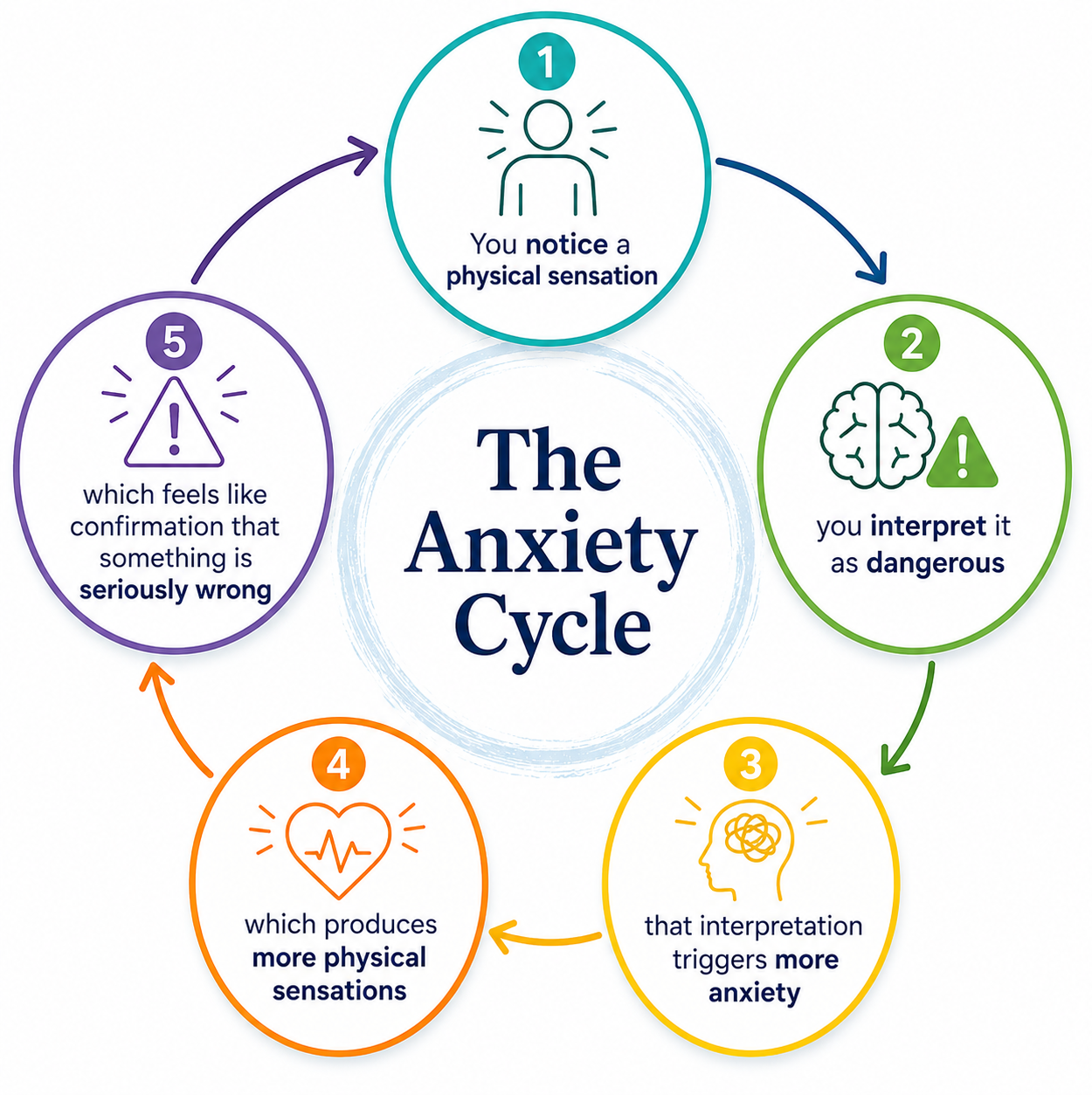
This is also why anxiety can create a vicious cycle. You notice a physical sensation → you interpret it as dangerous → that interpretation triggers more anxiety → which produces more physical sensations → which feels like confirmation that something is seriously wrong.
This loop is especially common in panic attacks, where the fear of the symptoms becomes its own trigger, feeding the response it's afraid of.
What Actually Helps
The good news is that, because anxiety operates largely through the body, the body is also one of the most effective entry points for calming it down. Talking yourself out of anxious thoughts in the middle of a spike rarely works well, because the thinking brain is temporarily less accessible when the alarm system is active. Working with the body tends to be more effective in the moment.
• Slow, extended exhales. Breathing is one of the few automatic body functions you can consciously control, which makes it a direct lever on the nervous system. The key isn't just deep breathing — it's making your exhale longer than your inhale (try inhaling for four counts, exhaling for six or eight). Longer exhales activate the vagus nerve and shift your body toward the parasympathetic “rest and digest” state.
• Grounding through the senses. Naming five things you can see, four you can hear, three you can touch, two you can smell, and one you can taste pulls attention out of the spiraling thought loop and back into the present physical environment, interrupting the feedback cycle.
• Movement. Because anxiety prepares your body for action that often never happens, that built-up energy has to go somewhere. A brisk walk, shaking out your hands, or even just pacing can help metabolize the stress hormones circulating in your system.
• Progressive muscle relaxation. Deliberately tensing and then releasing muscle groups, working from your feet up to your face, can reduce the physical tension anxiety leaves behind and signal safety to your nervous system.
• Cold exposure. Splashing cold water on your face or holding an ice cube can trigger the mammalian dive reflex, which slows heart rate and can interrupt an escalating panic response.
• Naming what's happening. Simply saying to yourself, “This is my nervous system's alarm going off, not an actual emergency” can reduce the second layer of fear — the fear of the fear itself — even if it doesn't stop the physical sensations immediately.
Playing the Long Game
In-the-moment tools help with acute spikes, but the deeper work of reducing anxiety's grip usually involves addressing the nervous system's baseline sensitivity over time. Regular physical activity, consistent sleep, reduced caffeine and alcohol, and practices like meditation or yoga all lower your overall stress reactivity, meaning your alarm system doesn't fire as easily or as intensely.
Therapy — particularly approaches like cognitive behavioral therapy (CBT) and somatic-based therapies — can also help retrain both the thoughts that trigger anxiety and the body's learned stress response over time.
The Bottom Line
Anxiety feels physical because it is physical — a real, evolutionarily ancient response happening in your body, not a character flaw or a sign of weakness. Understanding this can be genuinely relieving in itself: the racing heart, the tight chest, the churning stomach are not signs that something is broken. They're signs that a very old alarm system is doing what it was built to do, just at the wrong moment. With the right tools, you can work with that system instead of being at its mercy.
If anxiety symptoms are frequent, intense, or interfering with your daily life, it's worth talking to a doctor or mental health professional — both to rule out other causes and to explore treatment options that can help.